A product leader's field notes on building a brand from zero with AI, and where human advantage fits into the build.
I built the entire Kind but Tough (kbt.rocks) brand and website with Claude, as a product leader and coach; I'm not an engineer or designer. The color system, the prototypes, the design components, the copy, the move to production. All of it from ground zero, no templates.
I jumped in with Claude as my build buddy. The prompt engineering was the easy part. The humbling part is knowing that the tool is only as clear, sharp, or brave as the person prompting it.
I didn't set out to build a perfect site. I set out to ship a good one, fast, with strong thinking underneath it. An MVP with conviction. Shipping before it's perfect isn't lowering the bar. It's the discernment to know when the thinking is right, and having the conviction that where you landed is a strong enough foundation to build on.
Because the tool can build almost anything, the constraint is knowing what to build and when to step away from the keyboard. That didn't come from the LLM. It came from me.
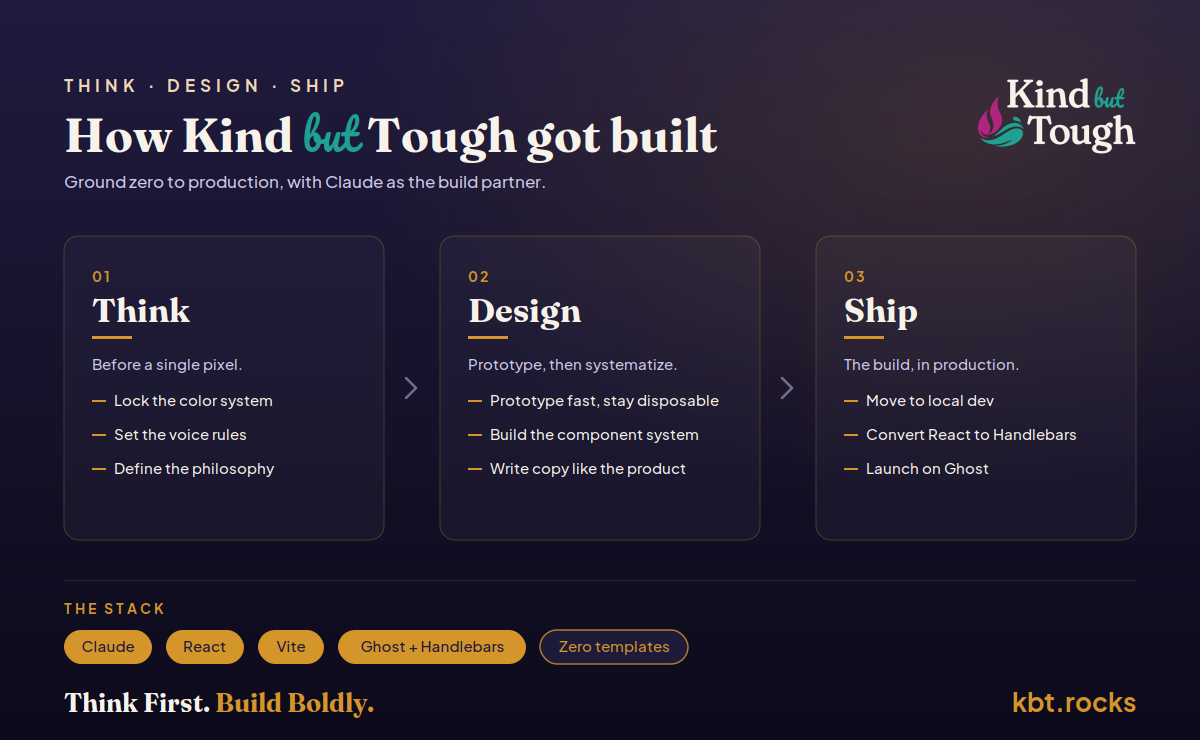
Phase I — Think First, before you prototype.
The most common mistake with AI is opening the prompt box and not providing enough real context. Instead, I started with decisions.
The palette came before the code. Five colors, each with a human job, not just a hex value. Deep Rose carries warmth and fire, the energy behind the speaking. Moody Sage holds presence and conviction, the ground the coaching stands on. Warm Amber is the accent for strategy, the signal color of the product and AI frameworks. Rich Indigo is the structure underneath all of it, the dark ground the framework sits on and the color of nearly every headline. Parchment gives every idea room to breathe. Once that system was locked, prototyping moved fast, because I wasn't choosing color one screen at a time. I was applying a system.
The voice rules came before the copy. Declarative. No corporate hedging. Contractions over stiffness. Never "I help," and instead a focus on outcomes. And the word but between Kind but Tough always lowercase and italic, everywhere it appears, to mirror the exact balance of the philosophy. All of it put in place to avoid voice drift.
The philosophy came before the pages. Kind but Tough existed as my own leadership conviction long before it was a site. The build didn't create the brand. It expressed one that was already real, and true to me.
The lesson underneath all three: AI amplifies whatever you bring to it. Bring conviction, it compounds. Bring noise, it scales the noise.
Phase II — Prototype, then Build Boldly.
Prototype fast, and treat it as disposable. I built the homepage more times than I want to admit, so I won’t (haha). I can be a bit obsessive. But that's OK. I could spin up full working versions, fast, and throw them away. That's the point. Prototyping is where you zero in on the experience, not where you defend your first guess.
Build the real components once a direction earns it. When a direction finally held up, the sketches became a real system. Reusable pieces across pages. Consistent spacing. The small things nobody names but everybody feels, down to button animations and the faint amber breath behind the hero, with a guard that stills it for anyone who prefers reduced motion.
Write the copy like it's the product, because it is. The words aren't filler poured around the design. They're the thing people came for. Every line got held to the same voice rules as everything else. (Oh yeah, for the copy part, it was very iterative, and it might have gotten a bit competitive between myself, Claude, and Gemini).
The method that made all of it work: de-risk the thinking before you touch the code. Map the options, weigh the tradeoffs, land the decision, then build. Changing your mind during the strategic thinking phase costs nothing. Untangling bad production code costs plenty. So I spent the expensive thinking while it was still a conversation, and saved the building for calls I'd already made. That's not an AI trick. It's just discipline.
Phase III — Launch with Conviction. Never Ship Noise.
Choose the platform. I picked Ghost to host the site. It's not the flashiest option and not the easiest to spin up, but it owns my content, publishes clean, and gives me room to grow into a real, subscription based writing practice while optimizing for SEO (and hopefully, AEO).
The technical foundation is quiet but real. Ghost ships clean, semantic HTML with structured data built in, fast page loads, canonical URLs, and full control of the metadata. Search engines reward exactly that. And that same clean structure is what makes the pages easy for AI answer engines to parse and cite, which matters more every year, not less. When the canonical source is yours and it's built right, you win both the search result and the AI answer.
Move to local development. Prototypes can live in a chat window. A real site lives in a repo. I set up a local preview with Vite and a page switcher so I could click through all the pages the way a visitor would, catch the things that only show up in context, then convert the React prototypes into Ghost's Handlebars templates. That's the moment you stop sketching and commit, with version control and a real build behind you.
Bring in the right collaborator for the job. As part of my process, I was running two versions of Claude in two clear lanes. One in the browser as my thinking partner for strategy, design direction, copy, and architecture, where many decisions got made. And Claude Code in my editor, executing the production build against those locked decisions. Strategy in one room, execution in the other.
That split was my choice. I was building from scratch and wanted to prototype the whole thing first, in artifacts I could throw away, before I ever stood up a dev environment. Two lanes made sense because I was working in two modes: shaping it in the browser, then building it for real in the editor. But by the end, I'd moved primarily into Claude Code.
A product team doesn't need that split, and honestly, neither do I. Claude Code isn't just for engineers. PMs and designers can prototype in it directly, generate working code, explore an idea, without living in an Integrated Development Environment (IDE), and the desktop app makes that approachable. The browser-to-editor relay I ran mostly disappears: the codebase is already there, and whoever's shaping the work can do it in the same place it gets built, against the standards the project already enforces.
What doesn't collapse is the human part, deciding what to build, making the design calls, holding the standard. Those stay. What goes away is the mechanical shuffle I did by hand. The split was a moment in time, not a rule. Moving forward, I can run the whole thing from Claude Code. Different setups, same discipline: decide first, build second, and don't let the two bleed together. Find the path that works for you.
What worked, and what I'd do differently
What's live today is good enough, not finished. But the foundation under it holds: a locked palette, a real component system, a voice that doesn't drift. So every change from here is quick and efficient. None of it means starting over. That's what the thinking bought me: a site I can evolve for years without tearing it down.
But if I ran the project back today, even with strict voice rules, my human instinct is to over-explain. I need to trust that less-is-more from the start, so I definitely plan to go and strip back content, determining what is the right amount I want to say or give away up front.
I have some ideas on offering optimizations with applicable lead magnets, but I’m confident that what I built will allow me to easily spin up these changes when I’m ready.
Launching is never the end. It is usually just the beginning of something great that you keep optimizing.
Your thinking and judgment: the part that never gets automated
We all know at this point that Claude is pretty slick. And, where it is today versus 1 or 2 years ago, blows me away. I can use it to build anything, and that is why discipline matters more now than ever, not less.
The bottleneck in an AI-forward world is no longer capability or speed. It is judgment. What deserves to exist. What to kill. When something is done. That work is still mine. It's not going anywhere.
This is the same thing I tell every leader navigating AI right now. The winners in this era won't be the ones using AI to move blindly fast. They'll be the ones who stopped to think, brought the human judgment no model can replicate, and used the tool to compound it. It's the whole idea behind my Catalyst Framework™, a strategic thinking system for product leaders building in an AI-first world.
For product builders, shipping anything and everything just because you can isn't the answer. Noise in your product costs you. It drags customer experience and piles up technical debt and overhead. Use AI to solve real problems customers will pay you to solve.
Your judgment is the compass. AI is the catalyst that builds the right things faster. That's your Human Advantage.
Think First. Build Boldly.
Check it out at → kbt.rocks